

Cyanuric Acid (Pool Stabilizer): The Right Level and How to Adjust It
Cyanuric acid protects chlorine from sunlight, but too much makes chlorine nearly useless. Here's the right target level, how CYA changes your free chlorine floor, and the only reliable way to lower it.
Mid-summer heat burns through free chlorine faster than almost anything else in pool care. If you add chlorine every evening and wake up to a near-zero reading, the problem is often not that you are adding too little. It is cyanuric acid (CYA), also sold as pool stabilizer or conditioner.
CYA is chlorine's sunscreen. The right amount keeps sanitizer in the water through a sunny afternoon. Too little and UV eats your FC before lunch. Too much and chlorine is still there on the strip, but it cannot kill algae and bacteria the way it should.
This guide covers the target range, how CYA changes your real chlorine floor, why levels creep up all season, and the only reliable way to bring high CYA back down.
What is cyanuric acid?
Cyanuric acid bonds with free chlorine and slows UV destruction. Without any CYA in an outdoor pool, sunlight can burn off most of your chlorine in a couple of hours on a bright day. With a healthy CYA level, that same chlorine lasts several times longer.
Think of it as sunscreen for chlorine. Protection is useful. Too much sunscreen and the chlorine works more slowly, so you need a higher free chlorine reading to get the same sanitizing power.
Target ranges:
| Pool type | Ideal CYA |
|---|---|
| Traditional chlorine (liquid, cal-hypo, tabs) | 30-50 ppm |
| Saltwater / SWG | 60-80 ppm |
| Indoor pool | 0 ppm (skip CYA entirely) |
Stay out of the "set and forget" trap above 80-90 ppm. That is where algae fights get expensive and shock stops working the way you expect.
Scan a strip in Pooli's Test Strip Scanning tool, then let the Water Report use your CYA to set a CYA-adjusted free chlorine target instead of a flat 1-3 ppm.
How to test CYA accurately
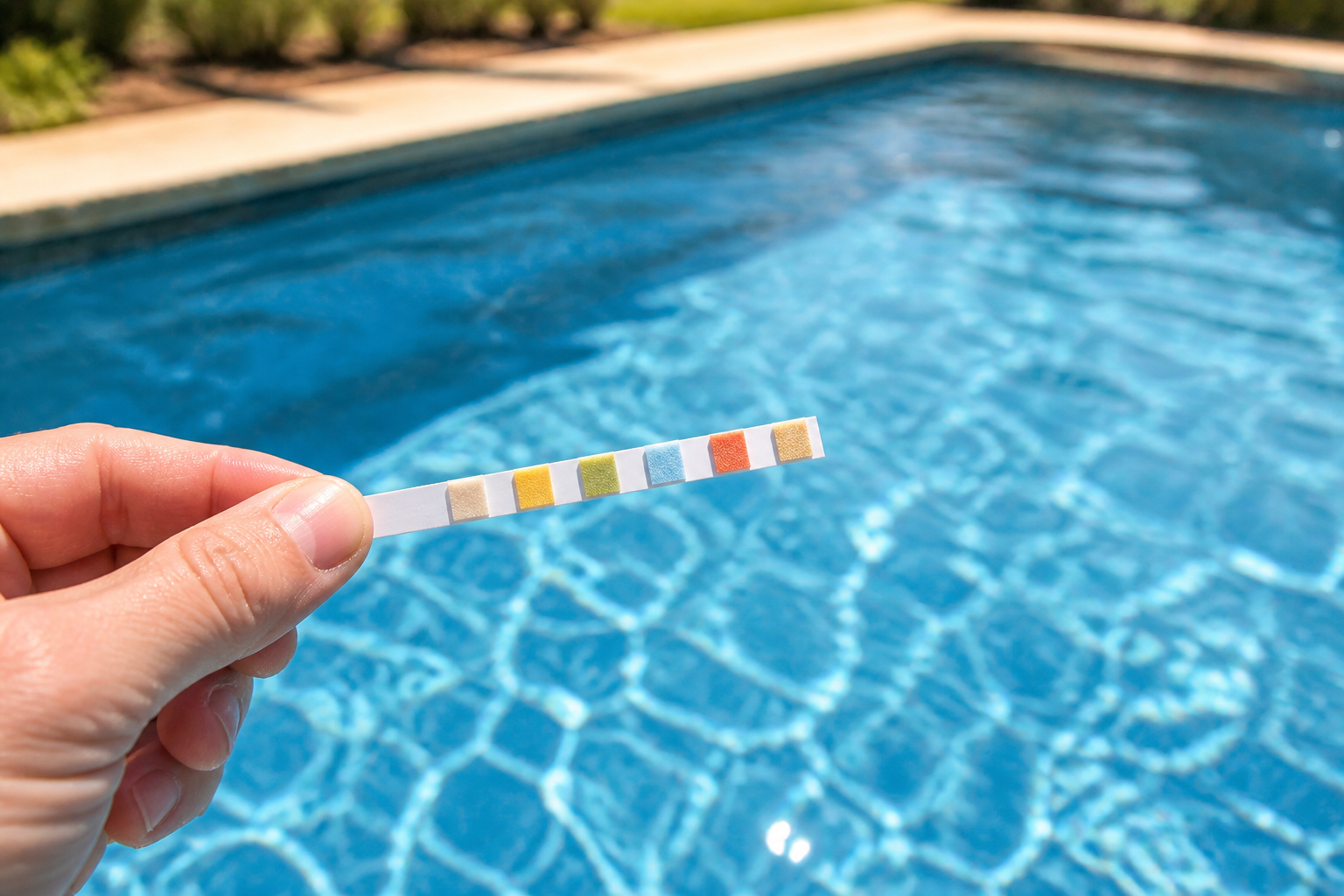
CYA is the pad most owners glance past. Test it at least monthly in swim season, and again after a big tablet season or any partial drain.
- Test strips: Fast. Good for trend watching. Photograph the strip in Pooli's Test Strip Scanning tool so the CYA pad is logged with everything else.
- Drop / turbidity kits: Better when you are dialing in a raise or confirming a high reading before you drain. CYA tests often use a cloudy "disappearing black dot" vial. Follow the kit's wait time.
- Pool-store reports: Fine as a checkpoint. Import the printout with Pooli's Universal Test Scan so the number lives in your history.
Retest 24-48 hours after you add stabilizer. CYA dissolves slowly and can read low if you test too soon.
Your free chlorine floor depends on CYA
A "normal" 2-3 ppm free chlorine reading only means something if you know your CYA. As CYA rises, you need more FC for the same kill power.
Minimum free chlorine for a standard chlorine pool (matches Pooli's CYA-adjusted targets):
| CYA (ppm) | Min free chlorine (ppm) |
|---|---|
| 20-30 | 2 |
| 40 | 3 |
| 50 | 4 |
| 60-70 | 5 |
| 80 | 6 |
| 90 | 7 |
| 100 | 8 |
| 120+ | 9 |
Salt systems follow a similar pattern but usually sit a bit lower on the FC side when the cell is healthy. Turn on CYA-Adjusted Chlorine Targets in Pooli so the Water Report raises your FC floor automatically when stabilizer climbs.
That is why "I hold 3 ppm and still get green" is so common in late summer. At 80 ppm CYA, 3 ppm FC is under-protected.
When Pooli builds a dosing recipe, it uses your pool volume, your product strength, and that CYA-aware target so you are not guessing ounces from a jug label.
How CYA rises over time
CYA does not burn off with sunlight the way free chlorine does. Evaporation concentrates it. Rain and splash-out dilute it a little, but tablet use usually wins the race.
What adds CYA:
| Product | Approx. CYA added per 1 ppm FC |
|---|---|
| Trichlor tablets / pucks | ~0.6 ppm CYA |
| Dichlor granules / shock | ~0.9 ppm CYA |
| Liquid chlorine (sodium hypochlorite) | 0 |
| Cal-hypo shock | 0 |
| Salt cell (SWG) | 0 (cell makes unstabilized chlorine) |
Most outdoor pools gain 20-30 ppm CYA per season from routine trichlor use. By mid-summer, a pool that opened at 40 ppm can be sitting at 70-90 without anyone noticing until chlorine "stops working."
The product differences are spelled out in Chlorine Types Compared: Bleach, Cal-Hypo, Dichlor, and Trichlor.
How to slow the climb:
- Use trichlor for maintenance only if you still need some CYA, then switch daily sanitizing to liquid chlorine or cal-hypo once you are in range.
- Prefer unstabilized shock when you boost FC.
- Log CYA monthly so the creep shows up on a chart, not as a green pool.
When CYA is too high (chlorine lock)
Above about 80-100 ppm, enough chlorine is bound that algae and bacteria get a free pass even when the strip looks "fine." People call this chlorine lock. The chemistry is more nuanced than a hard on/off switch, but the practical result is the same: you keep adding sanitizer and the pool still goes dull, hazy, or green.
Common signs:
- Adequate FC on the test, but algae still grows
- Shock that used to clear water in a day now barely moves the needle
- Persistent haze after parties even when pH and alkalinity look okay
- You are burning through chlorine without a matching FC rise
The only reliable fix is dilution. Drain 25-50% of the pool (more if CYA is well over 100), refill with fresh water, rebalance, and retest CYA.
Skip bottle "CYA reducers" that promise enzyme or phosphate-style magic. They rarely move a home test in a meaningful way. Partial drain and refill is the method that works.
After you refill, use Add Water in Pooli (tap + → Add Water) to log the fill volume so your history and future doses stay honest. Then retest CYA and free chlorine before you resume tablets.
If the water is already green while CYA is high, clear algae only after you understand the new CYA level. Pooli's AI Algae & Cloudiness Scan sizes shock against your real readings so you are not under-dosing into a high-CYA pool.
How to raise low CYA
Low CYA (under ~30 ppm outdoors) means you are buying chlorine for the sun. Stabilizer fixes that.
Product: Cyanuric acid granules (labeled stabilizer or conditioner)
Rough dose: about 13 oz per 10,000 gallons raises CYA by 10 ppm
Steps:
- Test current CYA and decide your target (usually 30-50 for chlorine pools).
- Calculate the dose for your pool volume. Pooli's Smart Chemical Dosing Recipes will size stabilizer for the ppm rise you want.
- Dissolve granules in a bucket of warm water. CYA dissolves slowly. Do not dump dry powder in a pile on the floor.
- Add the slurry slowly through the skimmer with the pump running, or per the product label.
- Run the pump 24 hours. Wait 24-48 hours before retesting CYA.
- Once CYA is in range, maintain with unstabilized chlorine so you do not overshoot.
Pooli's Adverse Effects Warning helps you see when a big stabilizer add sits alongside other pending doses so you are not stacking corrections blind.
Saltwater pools and CYA
Salt cells make unstabilized chlorine, so they do not add CYA by themselves. You still want stabilizer in an outdoor salt pool so midday sun does not wipe the residual FC.
Most SWG owners do well around 60-80 ppm CYA. Below that, the cell works harder on bright weeks. Above ~90, you get the same lock symptoms as a tablet pool.
Track cell output and salt level in Pooli's Salt Water Generator Tracking, and keep CYA on the same monthly test cadence as free chlorine. If you ever used trichlor "for a boost" in a salt pool, expect CYA to climb for the same reason it does everywhere else.
Indoor pools: skip stabilizer
No UV means no sunscreen benefit. Indoors, CYA only slows chlorine. Keep CYA at 0 (or as close as your fill water allows), and sanitize with unstabilized chlorine.
If an indoor pool somehow reads high CYA from a past tablet habit or a shared equipment setup, dilute the same way you would outdoors.
A simple summer CYA checklist
- Test CYA now (and monthly through peak swim season).
- Compare FC to the chart for your current CYA, not a generic 1-3 ppm goal.
- If CYA is under 30 outdoors, raise with stabilizer to 30-50 (or 60-80 for SWG).
- If CYA is over 80-90, plan a partial drain and refill. Do not keep stacking trichlor.
- Switch maintenance chlorine to liquid or cal-hypo once CYA is in range.
- Log readings in Pooli so the Water Report keeps your FC floor honest as summer heat and tablet use push numbers around.
Clear water in a heat wave is mostly enough free chlorine for your real CYA, plus a filter that can keep up. Get stabilizer in the right band once, stop feeding it by accident, and mid-summer stops feeling like a daily chlorine emergency.