

Iron and Metal Stains in Your Pool: Causes, Treatment, and Prevention
Rust-brown stains on plaster are almost always metals, not dirt. Here is how to prove it with vitamin C, lift the stain, and stop well water from putting it back.
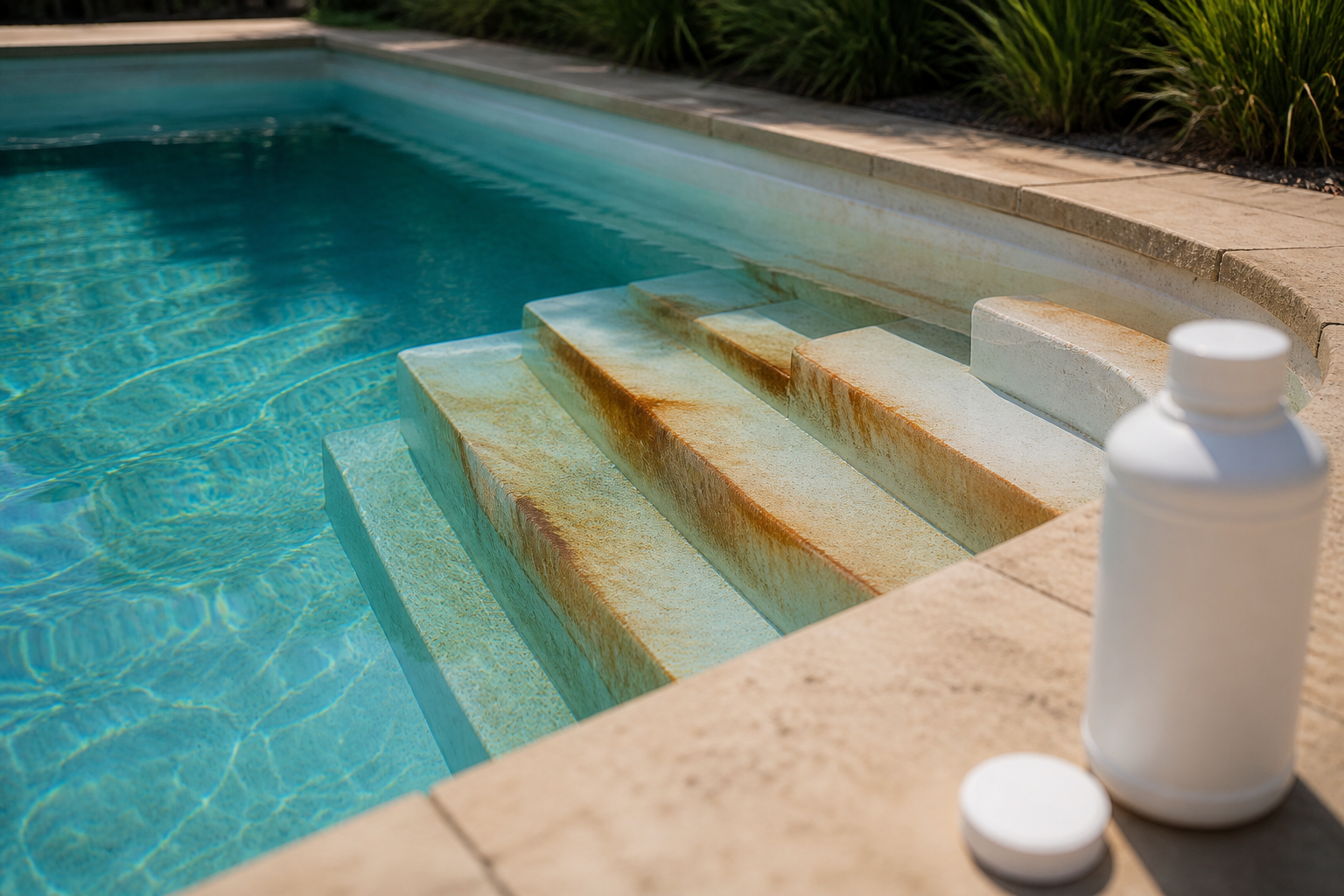
Rust-brown stains on the steps or the shallow end are almost never dirty plaster. They are metals. Iron is the usual suspect. Manganese and copper show up too. Shocking, brushing harder, and waiting for summer heat to burn it off make the stain darker.
This guide covers the 60-second vitamin C test, how to tell iron from copper from manganese, how to lift the stain without wrecking your chlorine, and how to stop well water from putting it back during peak swim season.
Prove it with vitamin C
Metal stains (iron, copper, manganese) lighten with ascorbic acid. Organic stains from leaves, algae, or berries do not. Calcium scale does not.
Wet the stain. Crush a vitamin C tablet, or pinch ascorbic acid powder, onto it. Wait up to 60 seconds.
- Lightens or disappears: metal. Treat as iron, copper, or manganese.
- No change: organic (shock and brush) or calcium scale (a scale product or acid wash, not vitamin C).
Do this on one small patch first. You do not need to dump a whole bag to identify the problem.
Standard 7-way strips skip metals. Scan one anyway before you treat. You need free chlorine and pH, because ascorbic acid fails if chlorine is still high, and it drops pH when it works. Scan the strip with Pooli SCAN Test Strip Reader so those two numbers are logged, not guessed.
If a pool store printed iron or copper on a report, import that slip with Universal Test Scanning so the metal reading sits next to the rest of the panel.
What the color is telling you
| Color on plaster, pebble, or vinyl | Likely metal | Typical source |
|---|---|---|
| Brown, rust, orange | Iron | Well water, fill water, corroding steel |
| Dark brown to black, sometimes purple | Manganese | Well water |
| Blue-green, teal, sometimes gray | Copper | Heater heat exchanger, copper algaecide, copper piping |
Iron is the most common backyard stain. Copper is the one people create by pouring a cheap algaecide. Manganese is the well-water cousin that looks almost black.
The vitamin C test does not tell you which metal. It only tells you it is a metal. Color plus your fill-water story usually does the rest.
Where the metals come from
- Well water. The classic. Clear going in, rust after chlorine hits it.
- Municipal fill water in iron-pipe towns. A hose left running overnight is enough.
- Corroding equipment. Steel fittings, rusty anchors, a dying heater with a copper heat exchanger.
- Copper algaecides. They kill algae. They also stain.
- Low pH. Acidic water strips metal from the heater and plumbing. The metal has to go somewhere. It plates onto plaster.
If stains return in the same spot after you lift them, the source is still feeding. Log the treatment date, product, and dose in Pooli's Treatment Progress Tracking. A second stain in the same week is a source problem, not a weak vitamin C dose.
A heater that keeps staining after pH has been low is worth a look in Equipment Registry: age, model, and whether that heat exchanger is copper.
Why shock and low pH make it worse
Dissolved iron is often invisible. Chlorine oxidizes it into rust, which stains. That is why a clear fill turns brown after you chlorinate, and why slamming shock onto an iron pool paints the steps orange.
pH under about 7.2, especially with low alkalinity, makes water corrosive. Corrosive water dissolves copper and iron from equipment. Then the metal lands on the plaster.
Do not shock to "clean" a rust stain. You will oxidize more metal onto the surface.
Keep pH at 7.4 to 7.6 once you are done treating. Sitting at 7.0 after the stain is gone is how the heater becomes the next source.
How to treat iron stains
Work in the evening so sunlight is not also chewing through your chemistry. Pump on. People out of the water.
- Get free chlorine down to 0 to 0.5 ppm. Stop the feeder, pause a salt cell, or wait it out. High chlorine destroys ascorbic acid and re-oxidizes the metal as fast as you dissolve it.
- Confirm pH. You will drop it on purpose in the next step. Know the starting number.
- Spot-treat first if the stain is small. Crushed vitamin C on the wet patch, nylon brush, wait. If the whole pool is rusted, skip to broadcast.
- Broadcast ascorbic acid at about 1 lb per 10,000 gallons as a common starting dose (follow the product label if you bought a stain treatment). Brush the stained areas while it circulates. Many rust stains lighten within an hour. Ugly ones take a few hours and a second dose.
- Add a metal sequestrant once the stain has lifted. This holds the now-dissolved metals in solution so they do not plate back on when you bring chlorine back.
- Run the filter 24 hours. Metals and spent ascorbic acid load the media. Plan a rinse, backwash, or cartridge clean after.
- Restore pH to 7.4 to 7.6. Ascorbic acid is acidic. Use soda ash (sodium carbonate), not a guess-and-pour of pH up.
Pooli's Smart Chemical Dosing Recipes will not invent an ascorbic acid dose. That is still the bag and your volume. Use it for the soda ash that puts pH back. Adverse Effects Warning matters here: a huge pH dump on low alkalinity bounces around by morning.
Use a nylon brush. A steel brush on plaster adds more metal.
After you clean the filter, see How to Clean a Pool Filter if you are unsure about sand vs cartridge vs D.E.
Put chlorine back without restaining
The stain is gone. The metals are still in the water, just sequestered. If you shock now, you can paint the pool again.
- Bring free chlorine up slowly over a day or two, not with a full shock bag the same night.
- Keep the sequestrant in the water. Follow the weekly or monthly maintenance dose on the bottle if you have well water.
- Retest pH the next morning. Ascorbic acid can keep pulling it down.
- Post-Dose Wait Guidance in Pooli covers the soda ash and the later chlorine addition: circulation time, then retest, then swim.
Do not swim until pH is back in range and free chlorine is at your normal target, not at 0.
For a testing refresher, see How to Test Pool Water. For why pH sits where it does, see Pool Chemistry 101.
Prevention that holds through swim season
Peak swim season is when people top off constantly. That is when iron shows up even if spring was fine.
- Keep pH at 7.4 to 7.6. Never let it sit under 7.2. That one habit protects the heater.
- Test fill water before a big refill. A white bucket of well water plus a cap of chlorine will often tint. That is your warning.
- Weekly sequestrant if the fill water has iron. Pooli's Smart Maintenance Reminders can carry a weekly sequestrant task so it does not die after one enthusiastic weekend.
- Inline iron filter or a hose pre-filter on well-water fills. Cheaper than another bag of ascorbic acid every month.
- Skip copper algaecides. If you need algae help, fix chlorine and CYA first.
- Do not leave the hose in overnight on a well without a filter.
Common mistakes
- Shocking the rust. Chlorine oxidizes iron onto the surface.
- Skipping the sequestrant. The stain lifts, then returns when free chlorine comes back.
- Leaving pH low after ascorbic acid. You will dissolve the heater next.
- Using a metal brush on plaster.
- Treating scale with vitamin C. If the tablet does nothing, you are in a different problem.
- Ignoring the source. Recurring stains mean well water, a copper product, or a dying metal part. The bag is not the strategy.
If you only remember one rule: vitamin C to identify and lift, sequestrant to hold, pH and fill water so it does not come back. Log the treatment so the next rust patch has a history instead of another guess.