

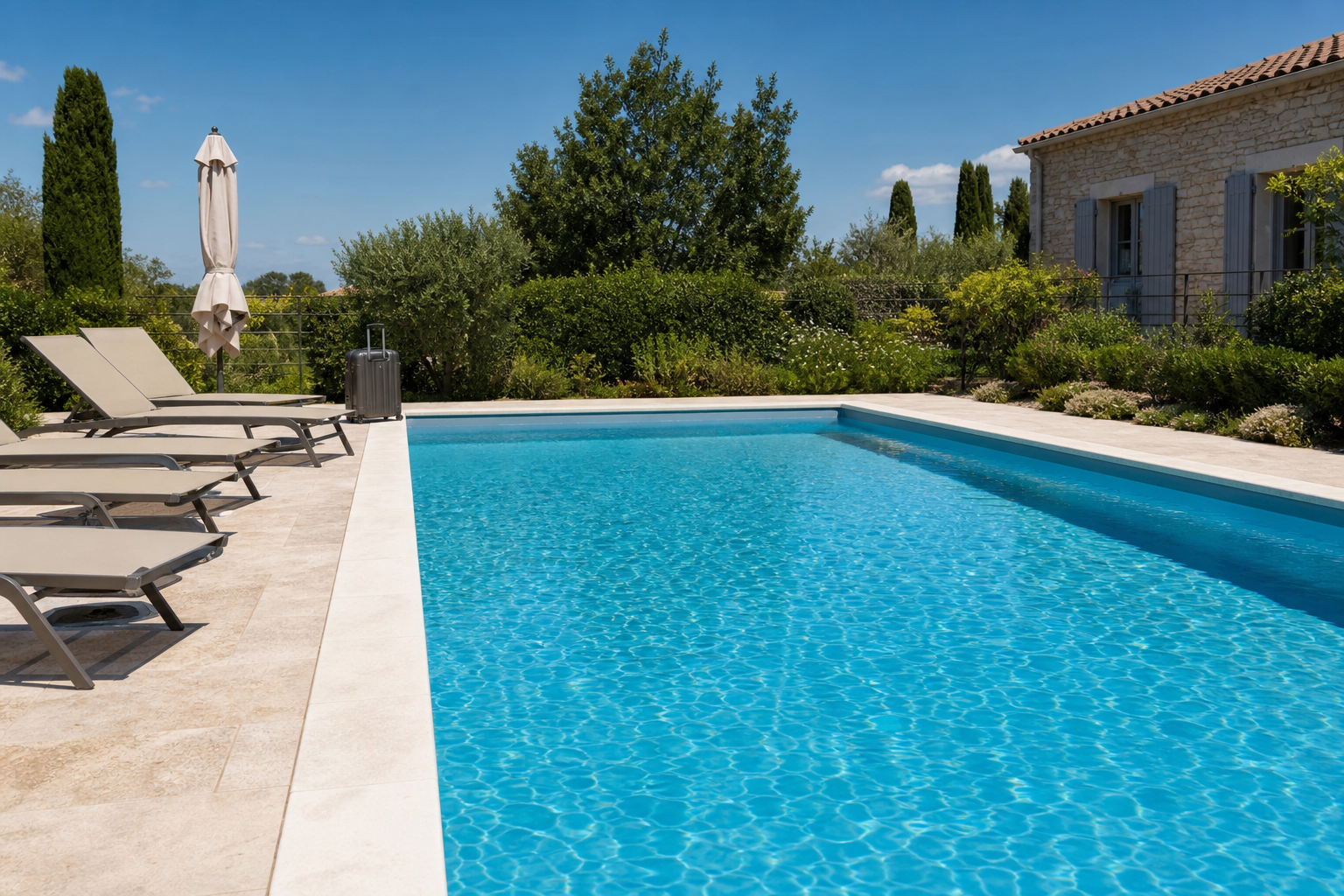
How to Take Care of Your Pool While on Vacation
Going away for a week or more? Here's how to keep your pool clean, safe, and algae-free while you're away, without hiring a full-time pool service.
Leaving town for a long weekend or a two-week trip does not have to mean coming home to a green swamp. With a solid prep night, steady sanitizer, and one trusted check-in person, most pools stay clear through peak swim season heat.
This guide covers how long a pool can sit, the five-step prep before you leave, automation that actually helps, what to ask a neighbor to do, and how to recover fast when you get back.
How long can a pool go without attention?
It depends on heat, sun, rain, and how balanced the water is when you walk out the door.
| Trip length | What you need |
|---|---|
| 1 to 3 days | Balanced chemistry is usually enough if the pump is on a timer |
| Up to 1 week | Pre-balance, bump free chlorine slightly high, empty baskets, set a floater or SWG |
| 1 to 2 weeks | Full prep plus algaecide, a cover if you have one, and a mid-trip check-in |
| More than 2 weeks | Plan on a helper visit or a one-time service stop |
Peak summer changes the math. Hot spells burn chlorine faster, storms dilute sanitizer, and wind loads the skimmer. Check Pooli's AI Weather & Storm Report for the days you will be gone so you can size chlorine and pump runtime for heat and rain, not for a mild week.
Before you leave: the 5-step prep
Do this the afternoon and evening before departure. Rushing it the morning of the flight is how people forget the skimmer basket.
1. Deep clean the pool
Vacuum the floor, brush walls and steps, skim the surface, and empty skimmer and pump baskets. Organic debris left behind consumes chlorine while you are away. A clean pool drifts slower than a dirty one.
If you own a robotic or suction-side cleaner, leave it on its normal schedule so debris does not sit for a week.
2. Test and balance the water
Aim slightly conservative, not perfect spa-day numbers. You want a buffer against sun and bather-free evaporation of chlorine.
| Parameter | Pre-vacation target |
|---|---|
| pH | 7.4 to 7.6 |
| Total alkalinity | 100 to 120 ppm |
| Calcium hardness | 200 to 400 ppm (match your surface type) |
| Free chlorine | 3 to 5 ppm (a touch high is fine) |
| CYA | 40 to 60 ppm for outdoor chlorine pools |
Scan a fresh strip with Pooli's SCAN Test Strip Reader, then follow the Water Report dosing plan so you are not guessing bag sizes the night before a trip. If a helper will test while you are gone, leave them strips and show them how a good reading looks in the app.
3. Shock the night before
Give the pool a full oxidizer dose the evening before you leave. Run the pump overnight so free chlorine settles into a normal residual by morning.
Use cal-hypo or liquid chlorine sized for your gallons and CYA. Pooli's Smart Chemical Dosing Recipes calculate the raise so you do not underdose in heat or overdose into a swim lockout when you return early.
4. Add a maintenance algaecide
A maintenance dose of algaecide is your safety net if sanitizer dips for a day. It is not a chlorine replacement. Think of it as a second line of defense while you are not there to retest.
Follow the product label for a preventative dose, not a kill dose meant for green water.
5. Top off the water level
Evaporation drops the level while you are gone, especially with uncovered pools in heat. Fill to the upper end of your normal skimmer window so the skimmer keeps pulling surface debris instead of sucking air.
If the level falls oddly fast after you return, treat it as a leak possibility. Log meter or fill notes in Pooli's Water Meter & Leak Detection tools so you can compare before-and-after usage instead of guessing.
Automation that actually helps while you are away
You do not need a smart home. You need reliable daily turnover and a steady sanitizer source.
Pump timer
Run long enough to turn the pool over at least once per day:
- Cooler weather: about 8 to 10 hours
- Peak summer heat: 10 to 12 hours (or longer on low speed with a variable-speed pump)
Confirm the timer is set before you leave. A pump that only runs three hours a day in peak summer heat is an algae invitation.
Automatic chlorinator or floater
A floating chlorinator with slow-release tabs, or an in-line feeder, keeps a residual without daily dosing. Load enough tabs for the trip length, and tell your check-in person where the spare bucket lives.
Salt water chlorine generator (SWG)
If you have an SWG, make sure salt is in range and the cell is set for unattended days (often a modest boost in peak heat). Track output and salt in Pooli's Salt Water Generator Tracking so you are not flying blind on whether the cell was actually making chlorine while you were gone.
Pool cover
A solar cover cuts evaporation, blocks debris, and slows UV burn-off of chlorine. If a full cover is impractical, even a liquid solar blanket helps hold heat and reduce overnight loss. Uncovered pools need stronger sanitizer planning.
Ask someone to check in
For trips longer than about a week, a human still beats any floater.
Ask a neighbor, house sitter, or family member to:
- Empty the skimmer and pump baskets every few days
- Glance at water level mid-week and top off if the skimmer mouth is exposed
- Confirm the floater still has tabs (or that the SWG display looks normal)
- Text you a photo if the water turns dull, cloudy, or green
Leave short written instructions: pump hours, where chemicals are stored, and what "normal" looks like. Better: share the pool in Pooli with Multi-Pool Share & Sync so they can log a skim, a strip scan, or a chlorine top-up, and you see it on your phone from the airport.
Set a mid-trip skim reminder in Pooli's Smart Maintenance Reminders on their account (or yours, if they will open the app) so the check-in does not rely on memory alone.
What to do when you return
- Look first. Clear blue, dull haze, or green? Slimy walls? Low water?
- Test immediately. Scan a strip in Pooli before you swim or dump more chemicals.
- Brush and vacuum anything that settled while you were gone.
- Shock if free chlorine crashed or the water looks off. Follow the Water Report dose, then run the filter.
- Clean the filter if pressure is high after the cleanup. A packed filter undoes a good shock.
If the pool is cloudy or tinted green, photograph it with Pooli's AI Algae & Cloudiness Scan for a shock multiplier matched to what you are seeing, then ask Percy follow-ups if the first pass does not clear it.
Do not swim until free chlorine and pH are back in a safe range for your pool type. The Water Report safety cues beat a guess from memory.
Mini Liquid Chlorine (12.5%) calculator
Signs something went wrong (and the fix)
| What you see | Likely cause | First move |
|---|---|---|
| Green or cloudy water | Chlorine depleted, algae start | Brush, clean filter, shock hard, retest |
| Strong "chemical" smell | Combined chlorine (chloramines) | Oxidize / shock, improve circulation |
| Slimy walls or steps | Early algae | Brush thoroughly, raise FC, consider algaecide |
| Low water level | Evaporation or a leak | Refill to skimmer line; bucket-test if it keeps dropping |
| Floater empty / SWG off | Sanitizer source failed | Restore sanitizer, then shock if water turned |
Most vacation disasters are preventable: dirty water on day one, no sanitizer source, short pump runtime, and nobody checking the skimmer.
The takeaway
Prep the night before like the pool will not see you for two weeks. Clean it, balance it, shock it, add a light algaecide, top off the water, and lock in pump hours plus a sanitizer source. For anything past a short getaway, share the pool in Pooli with a helper and give them one simple job list. When you get home, test first, then correct. Do that, and peak-season travel stops ending in a green-pool weekend.