

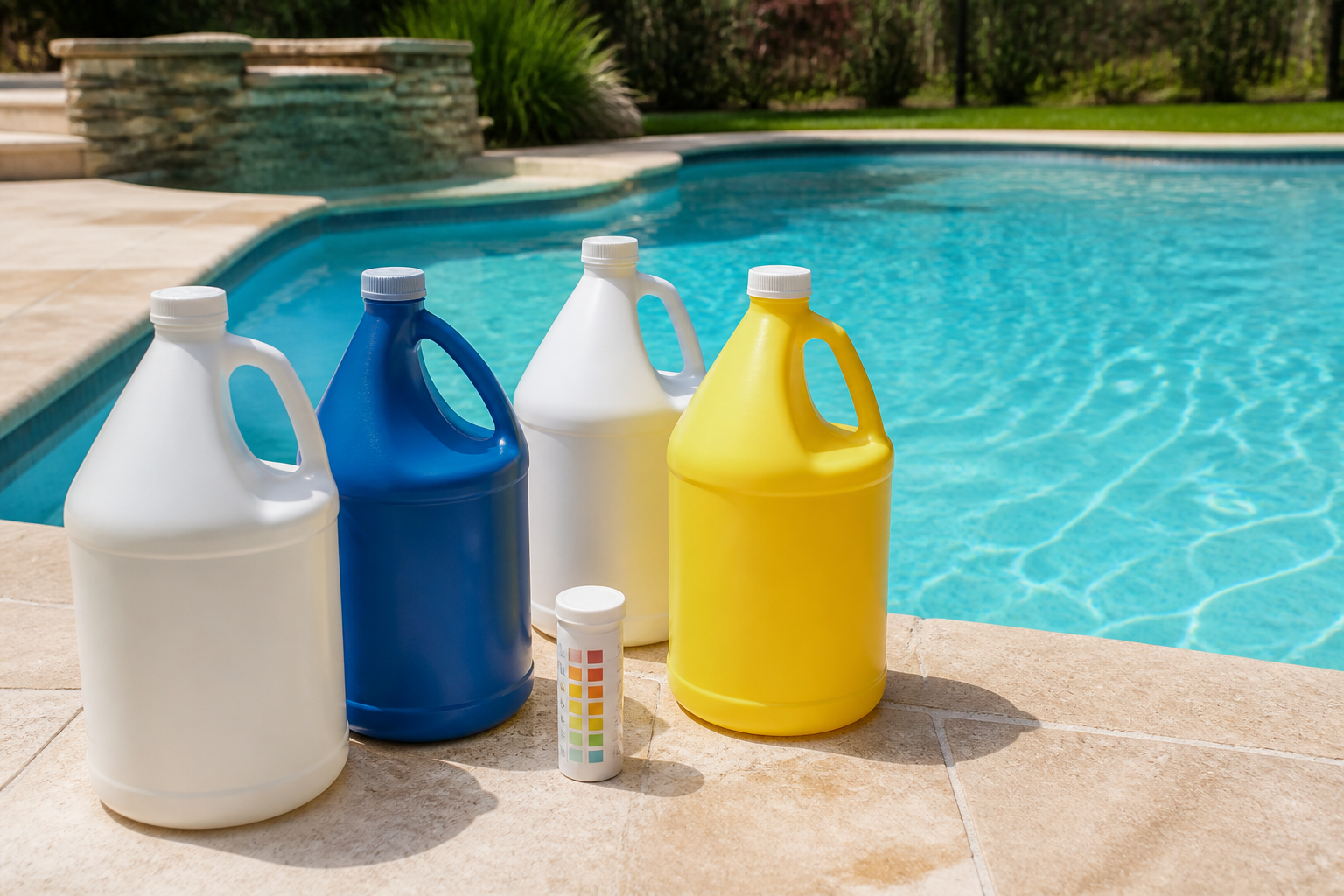
How to Add Chemicals to a Pool (The Right Order)
Adding pool chemicals in the wrong order can reduce their effectiveness, cause dangerous reactions, or permanently cloud your water. Here's the correct sequence.
Pool chemistry is not just picking the right products. Order, method, and timing decide whether those products work or fight each other. Get the sequence wrong and you can waste chemicals, cloud the water, or leave the pool unsafe to swim.
The generic DIY list you see online is usually alkalinity, then pH, then calcium, then CYA, then chlorine. That is a balance-only sequence. It skips the thing that matters first: whether the water is safe.
Pooli does not use that generic list. After you test, Add Chemicals (from the Water Report) follows the same groups as the in-app Why This Order? screen. Treatments are grouped by status first (To do, then In progress, then Awaiting retest). Within each group, Pooli follows this chemical order, and the biggest deviations from target are prioritized first.
The Golden Rule: Test First
Always test before you add anything. Adding chemicals without numbers is like adjusting a recipe without tasting it. You will often make things worse.
Scan a strip or log a Test Water reading in Pooli. From there you go into Add Chemicals. Tap Why This Order? on the Water Report if you want the same five groups this article uses.
How Pooli orders the work
Open treatments are grouped by status first: To do, then In progress, then Awaiting retest. Within each group, Pooli follows industry practice backed by CDC guidelines and professional pool service standards:
- Safety First
- Stabilize the Water
- Protect Pool Surfaces
- Efficiency Tweaks
- Cosmetics & Traces
Run the pump while you add, and wait between steps so the water actually mixes. Do not stack products from later groups on top of an unfinished safety problem.
1. Safety First
Correct sanitizer, algae, or cloudy water that could affect swimmer safety. This comes before alkalinity, pH, or calcium.
- Sanitizer too low or combined chlorine high: raise free chlorine (liquid chlorine, cal-hypo, or dichlor) or shock as the reading calls for. In Pooli, algae with free chlorine at 0 still uses the Shock and Slam flow (the old Algae scan, renamed), which sets the shock target from your test.
- Algae: brush, run the filter, and shock to the slam target. Do not spend the afternoon chasing pH while the pool is green.
- Cloudy water that could hide hazards: clarify or filter after sanitizer is working. Cloudiness is a safety issue when you cannot see the bottom.
Wait: circulate, then retest sanitizer before you treat it as done. Pooli's Add Chemicals flow shows wait times for the next product, a retest, or swim-ready.
2. Stabilize the Water
Total alkalinity first, because it buffers pH. If alkalinity is off, pH will not stay where you set it.
- Low: Add sodium bicarbonate (baking soda)
- High: Add muriatic acid or sodium bisulfate (pH decreaser)
Wait: circulate 4 to 6 hours and retest before moving on.
This is the step people mean when they say "TA first." In Pooli it is group 2, not group 1. Safety work still wins if sanitizer, algae, or cloudiness is open.
3. Protect Pool Surfaces
Adjust calcium and pH to prevent scaling or etching.
Once alkalinity is stable:
- pH low: Add sodium carbonate (pH Up / soda ash)
- pH high: Add muriatic acid or sodium bisulfate
- Calcium low: Add calcium chloride
- Calcium high: Partial drain and refill is the only real fix
Wait: circulate 2 to 4 hours and retest before other additions. Pooli's Adverse Effects Warning is there so you do not overcorrect pH while alkalinity is still low.
4. Efficiency Tweaks
Handle stabilizer (CYA), salt, or water replacement when levels are extreme. These are not "nice to haves" when they are way off. They change how well chlorine works and whether the rest of the plan is even possible.
- CYA low: Pre-dissolve in a bucket of warm water, or add to the skimmer with the pump running. Wait 24 to 48 hours before you trust a test result.
- CYA high, or salt far out of range: Partial drain and refill is often the real fix, not another bottle.
- Salt (SWG pools): Correct salt so the cell can actually make chlorine. Do not keep stacking shock if the cell is starved.
5. Cosmetics & Traces
Metals, phosphates, and minor clarity enhancers last. They do not make the water safe, and they do not replace sanitizer or balance.
- Metals (iron, copper): sequester after sanitizer and balance are in range, or you stain on the next pH swing.
- Phosphates: treat after algae and chlorine are under control. Phosphate remover is not a substitute for shock.
- Clarifiers and polishers: use when the water is already safe and balanced, and the filter can actually catch the leftover haze.
Mini Liquid Chlorine (12.5%) calculator
Chemical Safety Rules
Never Mix Chemicals Directly
Mixing concentrated pool chemicals can cause violent reactions, fires, or toxic gas. Always add chemicals to water. Never add water to chemicals, and never combine products in a bucket.
Separate Additions by Time
Wait at least 15 to 30 minutes (pump running) between different chemicals. For shock and algaecide, wait until chlorine drops to 5 ppm or below before adding algaecide.
Pre-Dissolve When Possible
For granular chemicals:
- Fill a bucket with pool water
- Add chemical to water (not the other way around)
- Stir to dissolve
- Pour the solution around the perimeter slowly
Add Chemicals With the Pump Running
Keep the pump on so chemicals dilute instead of sitting in a hotspot.
Shock at Dusk
UV destroys unstabilized chlorine. Add shock at dusk and run the pump overnight.
When to Add Each Chemical
| Chemical | Best Time to Add | Notes |
|---|---|---|
| Sanitizer / shock | Dusk for cal-hypo; evening or morning for liquid | Safety First. Run pump overnight after shock |
| Algaecide | Morning after shocking | Wait for chlorine to drop |
| Alkalinity Up | Anytime, pump running | Stabilize the Water. Wait 4 to 6 hrs |
| pH Up/Down | Anytime, pump running | Protect Pool Surfaces. Wait 2 to 4 hrs before retest |
| Calcium hardness | Anytime, pump running | Protect Pool Surfaces. Dissolve in a bucket first |
| CYA | Anytime, pump running | Efficiency Tweaks. 24 to 48 hrs to fully dissolve |
| Salt | Anytime, pump running | Efficiency Tweaks. Recheck SWG output after |
| Clarifier | Anytime, pump running | Cosmetics. Keep filter running 24 to 48 hrs |
After you log a dose, Pooli's Add Chemicals flow shows wait times for the next product, a retest, or swim-ready, so you are not stacking incompatible chemicals on the same visit.
Common Mistakes
- Fixing alkalinity while the pool is green or unsanitized: Safety First is still open. Balance will not make it safe.
- Adding shock and algaecide at the same time: high chlorine degrades algaecide immediately
- Adding acid directly to the pool without diluting: can bleach or etch surfaces
- Adding multiple chemicals at once without waiting: causes unpredictable reactions
- Testing immediately after adding chemicals: give chemistry time to circulate
- Not running the pump: chemicals will not mix evenly
- Treating metals or phosphates first: Cosmetics & Traces is last for a reason
See the in-app flow
The clip below walks test to dose, then the add order, the same path Pooli uses after Test Water. You test, the app builds the plan, and Add Chemicals steps you through it. Why This Order? on the Water Report is the five groups in this article.