

How Much Do Pool Chemicals Cost Per Year?
Pool chemical cost is what you buy, how often you use it, and the unit price. Here is the method, plus how Pooli turns inventory into a real total without a guessed yearly range.
How Much Do Pool Chemicals Cost Per Year?
You opened this for a yearly number. The honest answer is that there is not one national chemical bill. Two pools the same size can spend very different amounts, and a chart that says "small pools cost this, large pools cost that" is a guess dressed up as math.
The number you can trust is the one you calculate from what you buy, how often you use it, and the price on the container. That is the whole method. Pooli is the place to keep those three facts so you stop estimating.
The method: buy, how often, unit price
Write down every chemical you actually add. Not every product the store sells. Just the ones that leave your shed and go in the water.
- Sanitizer. Liquid chlorine, tablets, granular shock, or salt that the cell turns into chlorine.
- pH and alkalinity products. Acid, soda ash, baking soda.
- Stabilizer, calcium, and anything you only add a few times a year.
- Situational products. Metal treatment, clarifier, algaecide. Count them when you use them, not "just in case."
For each item, note two things: how often you use it, and the unit price on the jug, bag, or bucket. Monthly use times unit price is the monthly cost. Twelve of those months, adjusted for the months you close, is the chemical year.
If you do not know the unit price, you cannot know the cost yet. That is fine. Log the use anyway. The dollar stays blank until you add a price. Guessing a price so the total looks complete is how a blog range becomes your budget.
Saltwater is the same method with a twist. The cell makes chlorine, so you buy less sanitizer in bottles. You still buy acid, alkalinity products, and sometimes salt. The cell itself shows up on the electric bill, not in the chemical total. Keep those apart or the yearly number lies.
What not to do with a yearly estimate
Do not publish a range and call it typical. Pool size matters, but so do weather, how often people swim, whether you test before you dose, and whether you spent a week recovering a green pool. Those are habit and luck, not a lookup table.
Overcorrecting is the quiet cost. You add acid because pH looks high, then baking soda because alkalinity dropped, then chlorine because the last dose got burned off. Each addition was a real purchase. The yearly total is the sum of those purchases, not a feeling that chemicals "run a few hundred."
Test before you add. A reading logged in Pooli, from Test Strip Scanning or a drop kit, is what keeps the next purchase tied to the water instead of the calendar.
Where the chemical total actually lives
Once the products are in inventory and each one has a unit price, the yearly question is a report, not a spreadsheet you rebuild in spring.
My Inventory is the stock list. Personal and organization are separate, so a home pool does not mix with a route. Each row can show how much you have, monthly usage, and monthly cost. The monthly consumable cost at the top is the sum of items that have a price. The $39.36 on the screenshot below is one owner's logged inventory on his phone. It is not a typical monthly chemical bill, and it is not a target.
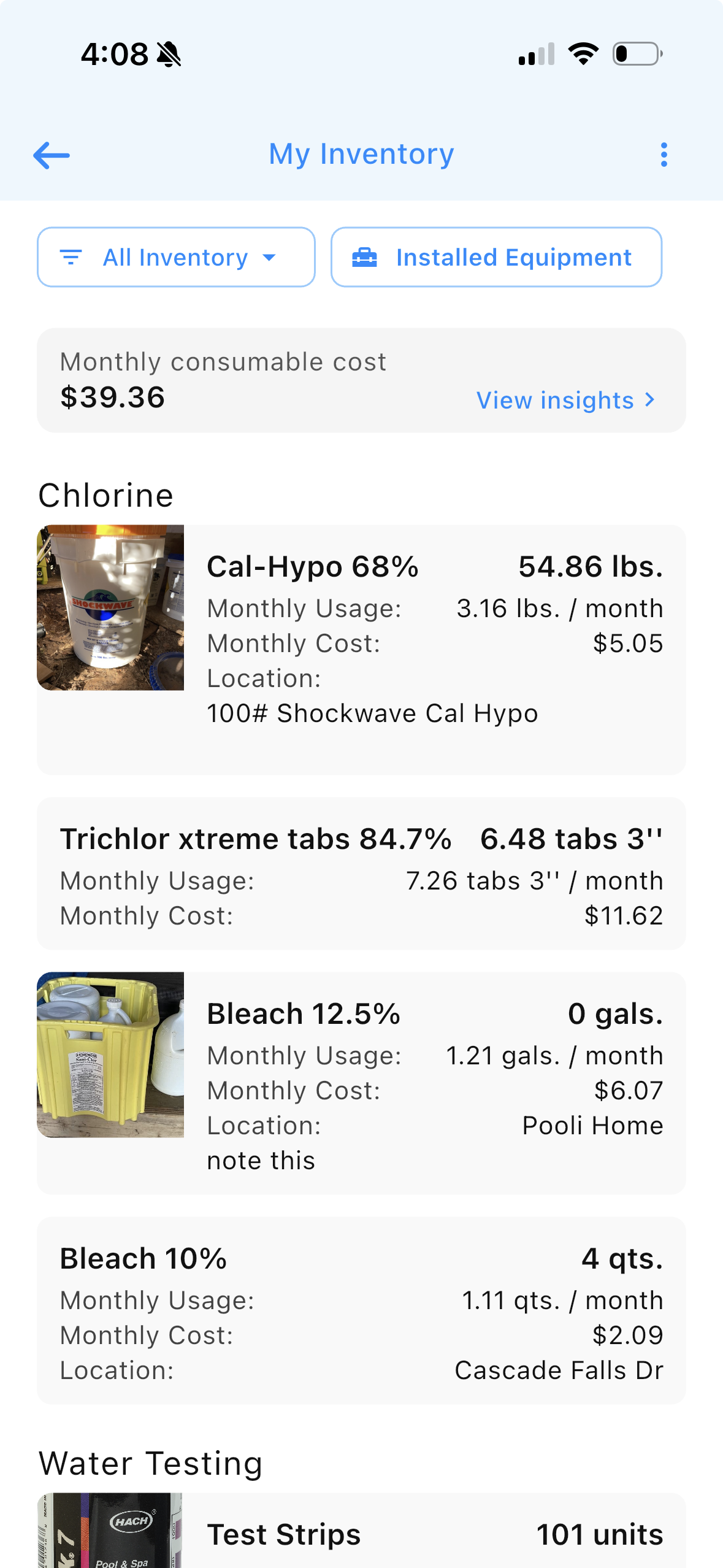
My Inventory: set a unit price and the row can show monthly usage and monthly cost. Without a price, usage can still be logged and the cost stays blank.
Inventory Usage by Pool rolls that up. Pick This Month, Last Month, or a custom range. You get total cost, how many usages, and a cost per pool. Some rows say some items have no unit price. That line is the point. The usage still counts. The dollar for that item stays empty until you add the price. Do not treat the totals on the screenshot as what pools cost. They are one account, one date range, with some prices missing.
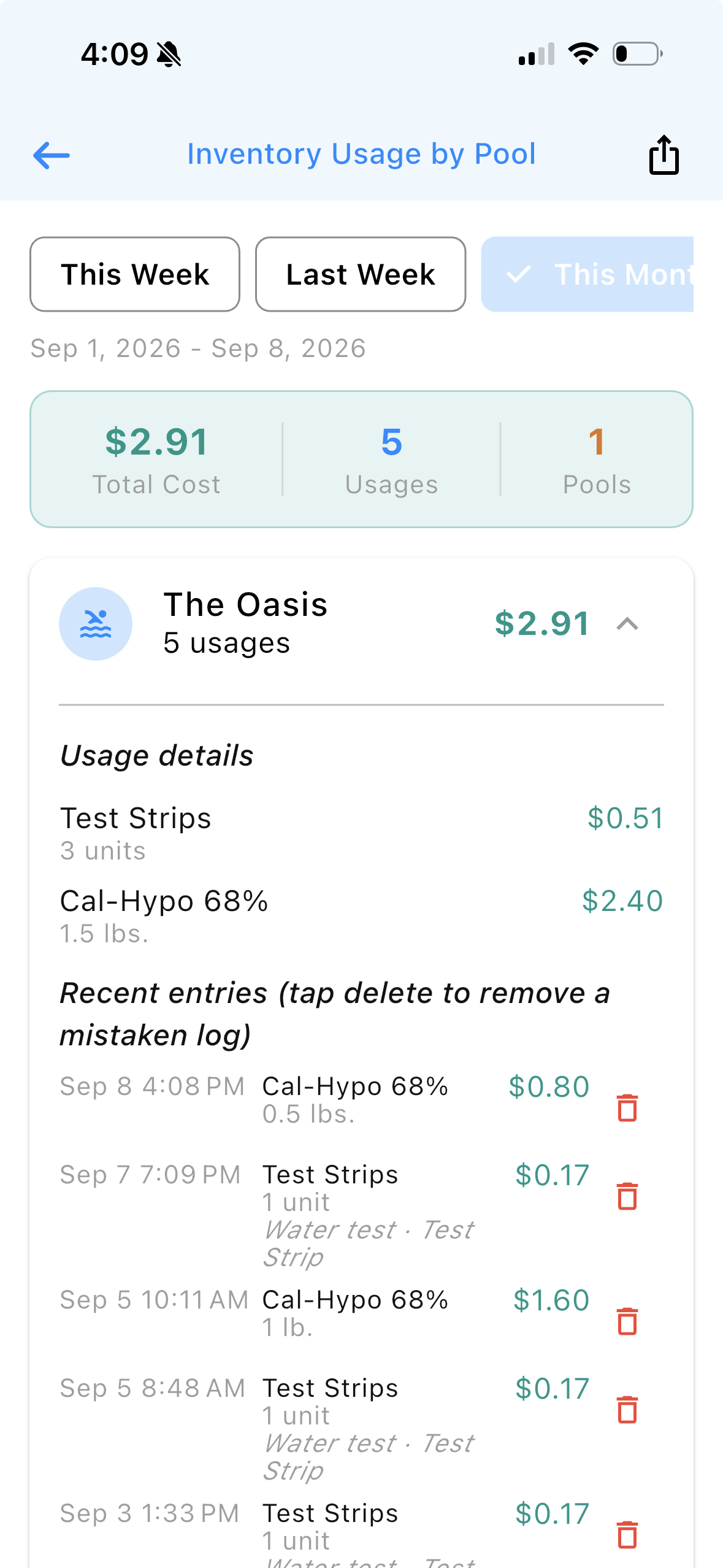
Inventory Usage by Pool: cost by pool for the range you pick. Items without a unit price stay out of the dollar total.
Pooli's Inventory Locations & Low-Stock Alerts are the same records. You are not keeping a second notebook. You log what you used, the unit price is on the product, and the usage screen does the multiply.
Chemicals are not the whole yearly bill
If you only add up jugs, you will think you know the operating cost and you will be short. The other half is equipment that runs whether or not you added chlorine today.
Cost To Operate is that half. You pick the equipment: Pump, Light, Heater, Robotic Cleaner, or Salt Water Generator. You enter watts, what you pay per kWh, and how many hours it runs. Pooli shows cost per day, month, and year for that piece, then a total across the equipment you added.
The screenshot is a pump at 600 watts, $0.11 per kWh, and 5 hours a day. That math is $0.33 a day, $10 a month, $120 a year. Those are example inputs on one phone, not what a pump costs everyone. Change the watts, the rate, or the hours and the year changes. A heater in cool weather and a pump that runs 12 hours are different bills.
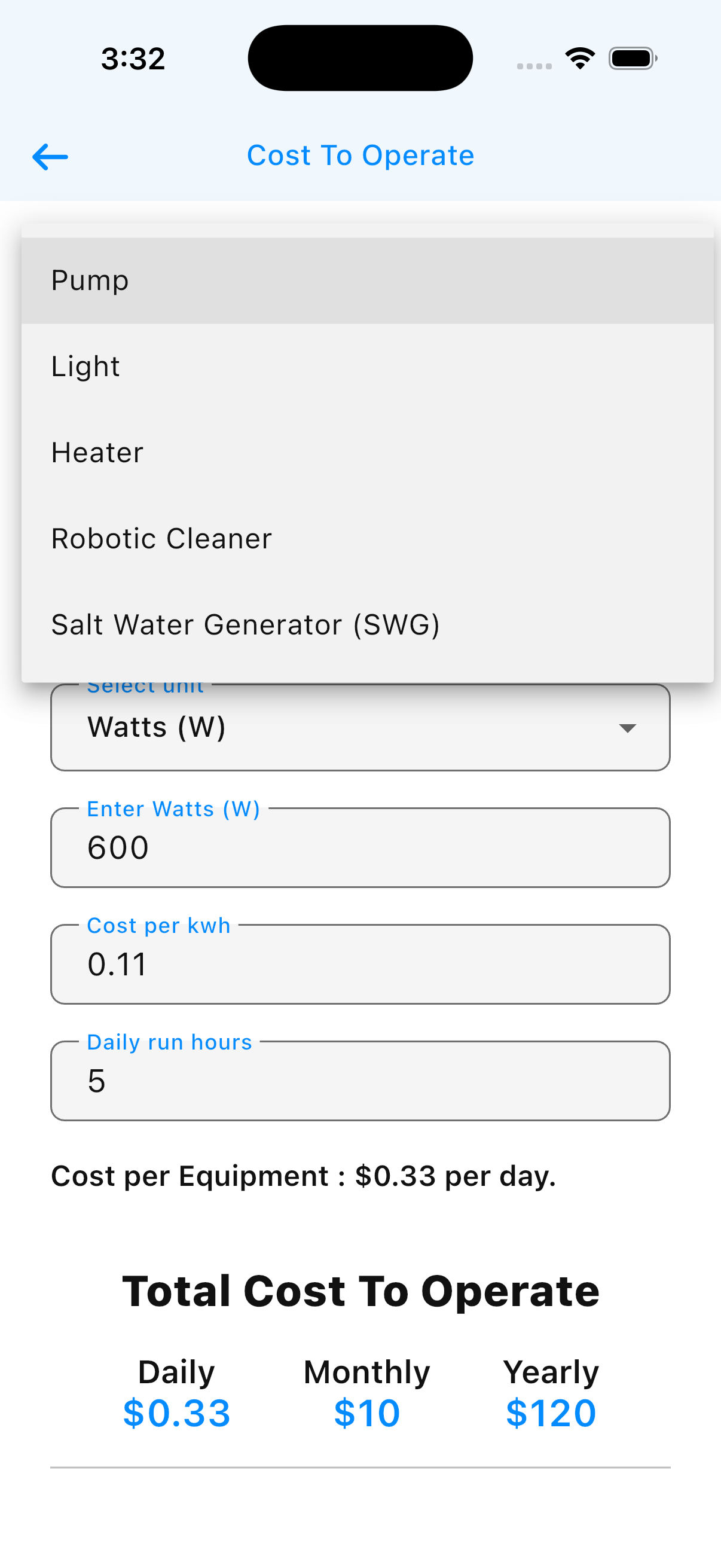
Cost To Operate: equipment energy, separate from chemicals. The $120 figure is this example's inputs, not a national pump cost.
Put the two numbers next to each other. Chemical cost from inventory usage. Equipment cost from Cost To Operate. That is the yearly picture. Chemicals are what you came for. They are not the whole number.
A short way to start
- Add the products you already own. Name, form, and unit price if you know it.
- Log use when you add it. If the price is missing, the usage still logs and the cost stays blank.
- After a month, open Inventory Usage by Pool for that range. That is your chemical month, not a blog estimate.
- Add the pump, light, heater, cleaner, or salt system in Cost To Operate so the electric side is not invisible.
The yearly chemical cost is the sum of those priced uses. Anything else is a guess.