

The 3 Types of Pool Algae and How to Kill Each One
Green, yellow, and black algae each need a different treatment. Learn to identify which type you have, then follow the right protocol (and let Pooli's AI scan confirm it) to clear it fast.
Nothing turns a backyard pool into a swamp faster than algae, and in peak summer heat it can bloom overnight. The good news: every outbreak is one of three types, and once you know which one you are looking at, the fix is straightforward.
This guide covers all three (green, yellow/mustard, and black), with the exact treatment for each, the products that clear them, and how Pooli's AI identifies the problem for you so you are not guessing under the sun.
Why Algae Grows in Pools
Algae is always present in pool water in microscopic form. It blooms when conditions tip in its favor: low sanitizer, high temperatures, weak circulation, or extra nutrients washed in by rain and organic debris.
The cure for all three types rests on the same foundation: enough free chlorine, balanced pH, and relentless filtration. What changes is how aggressive you have to be.
Start by scanning your test strip in Pooli's Test Strip Scanning tool to confirm your current free chlorine and pH before you treat. If chlorine is sitting low, that is almost always why the algae took hold in the first place.
How to Identify Your Algae Type
The three types differ in color, where they cling, how stubborn they are, and how much it costs to clear them. Use the comparison below as your quick reference, then jump to the section that matches what you see.
If you are not completely sure what you are looking at, do not guess. Open Pooli's AI Algae & Cloudiness Scan, photograph the water or the affected surface, and Pooli identifies the problem and hands back a shock multiplier tuned to your pool's CYA. There is a full walkthrough near the end of this guide.
Mini Liquid Chlorine (12.5%) calculator
Type 1: Green Algae (Most Common)
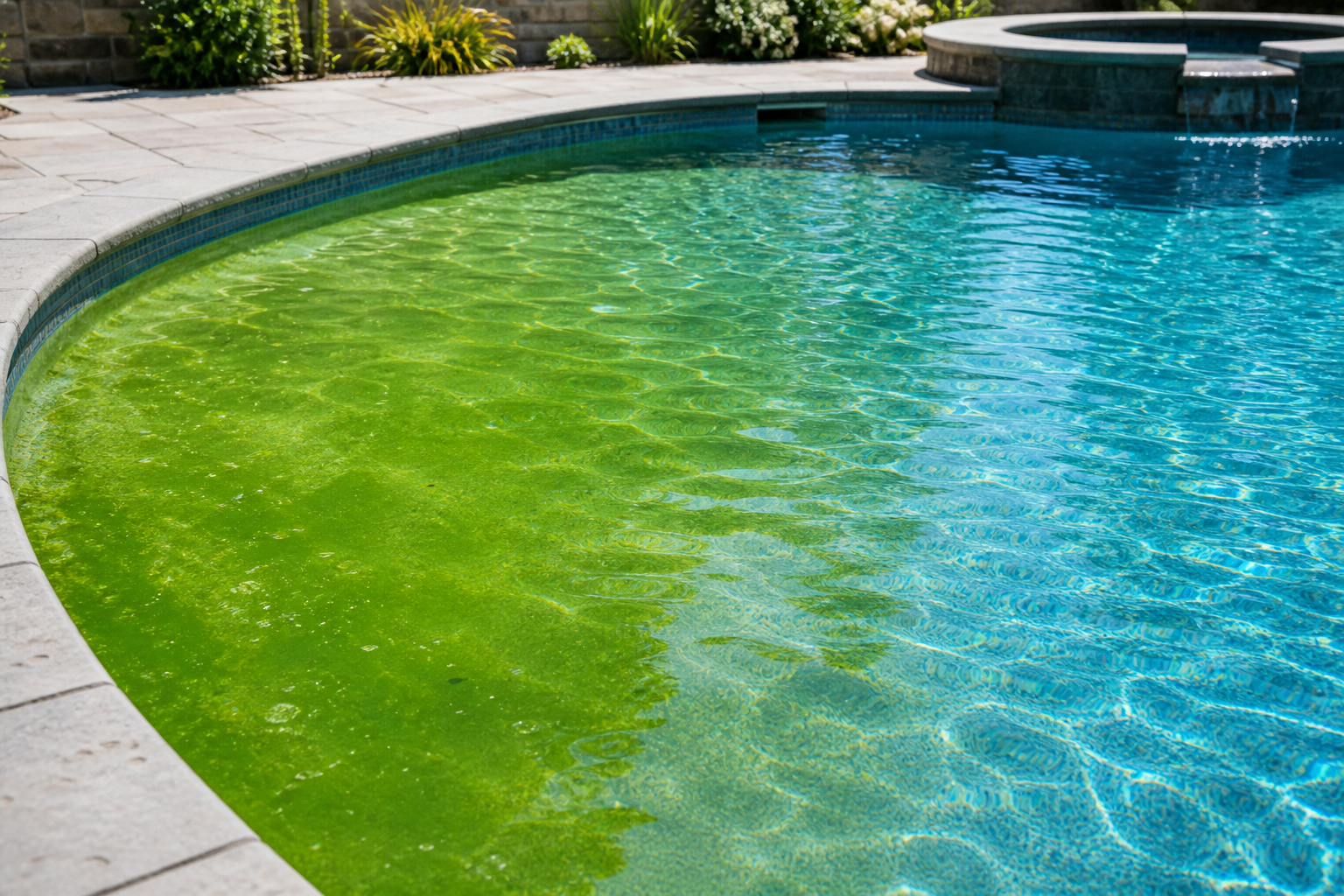
What it looks like: A green tint to the water, or green slime on the walls and floor. It ranges from light green in the early stage to deep swamp green in a full bloom.
Treatment:
- Brush every surface to knock the algae into suspension.
- Lower pH to 7.2 to 7.4 so your shock works at full strength.
- Double or triple shock with cal-hypo at night:
- Light green: 2 lbs per 10,000 gallons
- Medium green: 3 lbs per 10,000 gallons
- Dark green / swamp: 4 lbs per 10,000 gallons
- Run the filter continuously for 24 to 48 hours.
- Backwash when the pressure climbs.
- Retest. If it is still green, shock again the next night.
Log the treatment and check off Shock Pool (Algae) in Pooli so your dosing and follow-up stay on schedule.
As the dead algae clears, the water often turns cloudy. Keep the filter running and add a clarifier to help your filter grab the fine particles faster.
Type 2: Yellow / Mustard Algae
What it looks like: A pale yellow or sandy-colored powder, usually clinging to walls and steps in shaded areas. It is often mistaken for dirt or pollen.
Why it is harder: Mustard algae resists chlorine and can survive on pool equipment and accessories outside the water, which is how it keeps coming back.
Treatment:
- Brush all affected surfaces aggressively.
- Bring every piece of gear into the pool while you treat: brushes, vacuum hose, automatic cleaner, nets, toys, anything that has been in the water.
- Adjust pH to 7.2 and alkalinity to 80 to 100 ppm.
- Triple shock at minimum, 3 lbs of cal-hypo per 10,000 gallons.
- Add a copper-free algaecide labeled for yellow or mustard algae.
- Run the filter 24+ hours and backwash often.
- Repeat the shock if any algae is still visible after 24 hours.
Mustard algae spores cling to swimwear, so wash anything worn in the pool during an outbreak.
Type 3: Black Algae (Hardest to Kill)
What it looks like: Dark blue-green or black spots, usually on plaster, concrete, or gunite. Each spot has a tough protective layer.
Why it is the hardest: Black algae grows a protective coating over every colony that blocks chlorine, and it sends root-like structures down into porous surfaces. You have to break it open before any chemical can work.
Treatment:
- Use a stainless steel algae brush to physically break the surface of each spot. This step is not optional, it is what lets chlorine reach the colony.
- Rub a chlorine tablet directly on each spot for concentrated contact treatment.
- Adjust pH to 7.2 and alkalinity to 80 to 100 ppm.
- Triple or quadruple shock with cal-hypo.
- Add a quaternary ammonium algaecide.
- Run the filter 24 to 48+ hours and backwash every 4 to 6 hours.
- Brush daily and reapply chlorine to the spots.
- Repeat for several days in a row until the spots are gone.
Black algae rarely shows up on vinyl liner pools. If you have a vinyl liner and see black spots, it is more likely a stain from organic debris than algae.
Let Pooli Diagnose and Dose for You
Identifying algae by eye is where most people go wrong, and the wrong call wastes chemicals and days of swim time. This is exactly what Pooli's AI Algae & Cloudiness Scan was built for.
Here is the workflow that fixes problems fast:
- Add a water test first. Scan your strip with Test Strip Scanning so Pooli knows your free chlorine, pH, and CYA.
- Run the Algae & Cloudiness Scan. Photograph the water or the affected surface. Pooli's AI reads the image against your chemistry and returns a precise shock multiplier plus a step-by-step action plan, in order, with the prep work and follow-up care included.
- Get real-time, industry-leading feedback. The scan does not stop at a number. You can ask Percy, Pooli's AI assistant, follow-up questions to tailor the shock dose or clarify any step for your specific pool, right when you are standing at the water's edge.
Because the plan is built from your actual readings (not a generic chart), you treat the right type with the right dose the first time. That is the difference between clearing a green pool in 24 to 48 hours and fighting it for a week.
The more you use Pooli, the better it gets at keeping you ahead of algae: your test history, equipment, and treatments all feed your reminders and Water Report, so small problems get caught before they bloom.
Preventing All Algae
- Keep free chlorine above 1 ppm at all times. Test three times a week with Pooli.
- Shock weekly, especially after rain or heavy use.
- Run the pump at least 8 to 10 hours a day for solid circulation.
- Brush weekly even when the water looks clear.
- Add a weekly preventive algaecide dose if your pool is prone to algae.
Pooli's test reminders and task checklists make it easy to stay consistent. Algae prevention is about never letting your guard down, and getting to know Pooli is the simplest way to do that without it taking over your summer.